-
-
-

The Governance & Culture Reform hub is designed to foster discussion about corporate governance and the reform of culture and behavior in the financial services industry.

Need to file a report with the New York Fed? Here are all of the forms, instructions and other information related to regulatory and statistical reporting in one spot.

The New York Fed works to protect consumers as well as provides information and resources on how to avoid and report specific scams.
-
-
-

The New York Fed provides a wide range of payment services for financial institutions and the U.S. government.

The New York Fed offers the Central Banking Seminar and several specialized courses for central bankers and financial supervisors.

The New York Fed has been working with tri-party repo market participants to make changes to improve the resiliency of the market to financial stress.
-
-
-

We are connecting emerging solutions with funding in three areas—health, household financial stability, and climate—to improve life for underserved communities. Learn more by reading our strategy.
The Economic Inequality & Equitable Growth hub is a collection of research, analysis and convenings to help better understand economic inequality.
The Governance & Culture Reform hub is designed to foster discussion about corporate governance and the reform of culture and behavior in the financial services industry.
-



Settlement Fails in the Treasury Market after 9/11
| Recapping an article from the November 2002 issue |
|
||
| of the Economic Policy Review, Volume 8, Number 2 | View full article  |
||
|
|
23 pages / 251 kb | ||
|
Authors: Michael J. Fleming and Kenneth D. Garbade |
Disclaimer | ||
| Index of executive summaries |

|
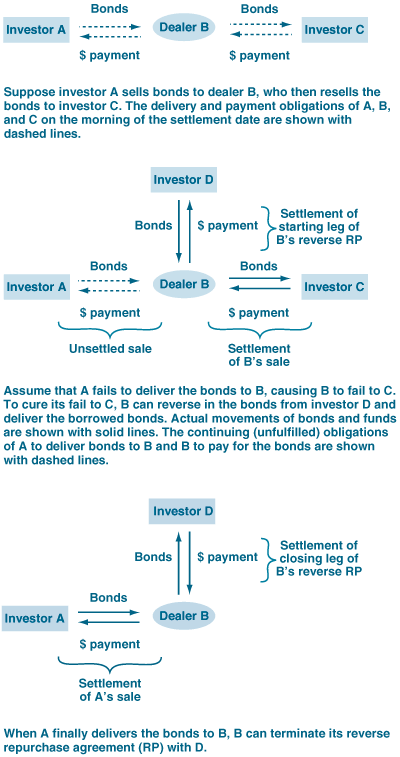
Overview Fleming and Garbade explain why a high rate of settlement fails persisted after September 11 despite actions by the Federal Reserve and market participants to ameliorate the problems caused by the attack on the World Trade Center. They argue that fails rose initially as a result of the destruction of records and communication facilities, but remained high because the means typically used to avert or remedy fails—borrowing a security though a special collateral repurchase agreement—proved as costly as failing to deliver the security. Background The magnitude of the settlement fails problem that arose in the aftermath of the attack was unprecedented in the history of the Treasury securities market and led Treasury to reopen the actively traded ten-year note with only two hours’ notice to market participants. Both the size of the problem and Treasury’s strong response make understanding the origins and context of the settlement fails problem particularly important. Argument and Methodology Fleming and Garbade begin their analysis with an overview of the settlement process in the Treasury securities market. They explain how settlement fails occur in the normal course of market functioning and describe the role of special collateral repurchase agreements in avoiding and remedying fails (exhibit). The authors then describe the initial effects of the September 11 attack on the settlement process. The destruction of trade records, brokers’ offices, and communication facilities caused settlement fails to soar. For the week ending September 19, fails averaged $190 billion per day, far exceeding the $7.3 billion daily average for the first eight months of 2001 (chart). The Federal Reserve responded quickly by suspending selected limits on its securities lending program, thereby making collateral more readily available to primary dealers. Concurrently, market participants worked to resolve the communication and operational problems caused by the attack. Fleming and Garbade go on to show that despite these steps, settlement fails continued at a high rate through the end of September. The authors argue that fails remained high because a relatively low federal funds rate and investor reluctance to lend securities kept the rates on special collateral repurchase agreements at or near zero. With such low “specials” rates, investors had little incentive to borrow the securities they needed to settle earlier trades. As concern grew that the level of fails was undermining market functioning, Treasury officials took the unprecedented action of reopening the ten-year note with only two hours’ notice. The additional supply raised the note's specials rate and increased investors’ incentives to settle their trades. Thereafter, fails declined quickly, dropping from a daily average of $142 billion during the week ending October 3 to $63 billion per day the next week, and then to roughly $18 billion per day in each of the following two weeks (chart). Findings The authors attribute the persistence of fails following September 11 to specials rates that were near zero for several actively traded securities. In effect, the cost of borrowing securities to avert or remedy a fail during this period was virtually as high as the cost of failing. Treasury’s action to reopen the ten-year note raised the specials rate and made borrowing the note more attractive than failing. Fleming and Garbade conclude their analysis with a look at long-run reforms to alleviate chronic fails. One initiative considered is the creation of a Treasury facility that could lend specific securities on a temporary basis during periods of high demand. Chronic fails could also be reduced, the authors suggest, through the institution of a penalty fee for fails. |
|
|
|
|
|
|
| Borrowing Securities to Cure a Settlement Fail | |
|
|
|
|
|
Settlement Fails in U.S. Treasury Securities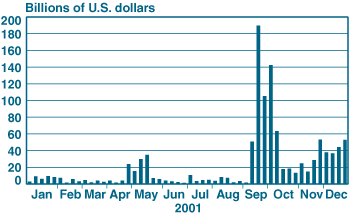
Source: Federal Reserve Bank of NewYork. |
|
| Disclaimer | |
|
The views expressed in this article are those of the authors and do not necessarily reflect the position of the Federal Reserve Bank of New York or the Federal Reserve System. |
|